
Fully Accessible For Who?
“Fully accessible for who?”
It is a question I come back to again and again, because accessibility is not one fixed thing. It is not a single feature, a simple label, or a filter you can tick and forget about. It changes from person to person, from place to place, and sometimes, for the same disabled person, from one day to the next.
In the first blog post in this series, I looked at what happens when venues claim to be accessible but key details are missing. This time, I want to go a step further, because the issue is not only that “fully accessible” can be misleading. It is that it assumes accessibility means the same thing to everyone.
It does not.
As a wheelchair user, I know how quickly one missing detail can change the whole shape of a day. A heavy door, a long route, a fixed table, a toilet that technically exists but is impossible to use comfortably. Those things matter to me, but my version of accessibility is not the only version.
A feature that gives one disabled person freedom might create a barrier for someone else. That is why a single label does not give us enough information to make a decision.
Accessibility is not one feature
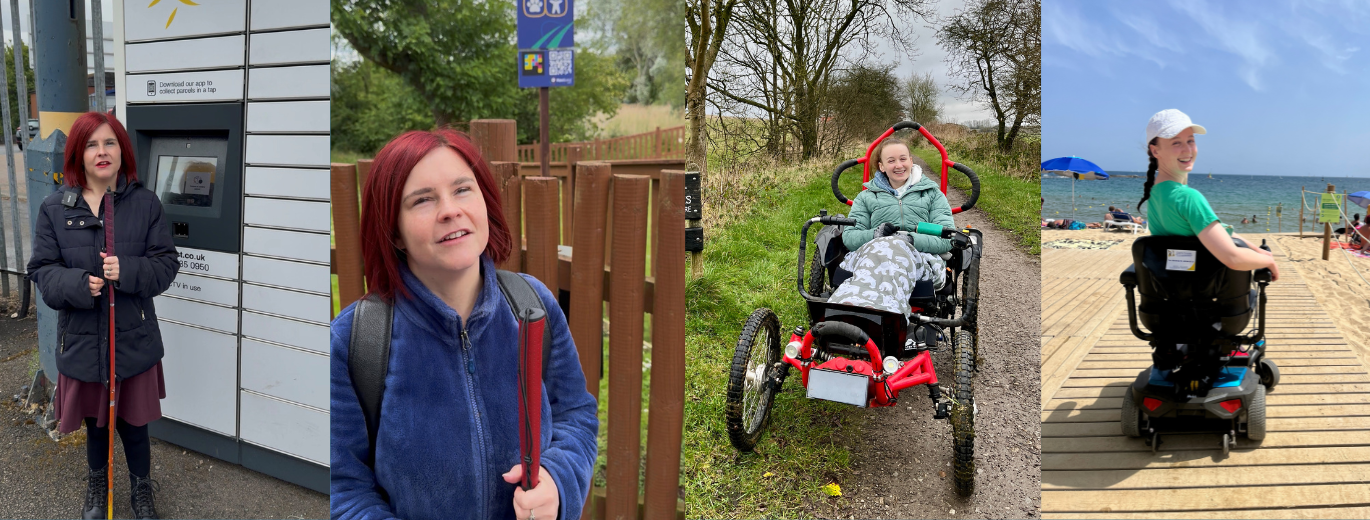
Sassy Wyatt loves going to theme parks, but as someone who is blind and has arthritis, a day out can quickly become exhausting and overwhelming. Long queues can cause significant pain and brain fog, while large parks can be difficult to navigate without clear information. When that information is missing, independence can start to disappear before the fun has even begun.
When a theme park provides detailed access information through AccessAble Guides, disability access passes, step-free routes and technologies such as NaviLens, it changes the day. Sassy can plan ahead, decide where to stop and rest, and navigate more independently.
It also means she can enjoy the experience with friends or family, rather than spending the whole day focused on managing pain, fatigue and uncertainty.
Too often, accessibility is reduced to one adjustment: a ramp, a toilet, a lift, a parking bay. For Sassy, it is the combination of information, route planning, rest opportunities, navigation support and personal choice that makes the difference.
What works for me may not work for you
Sassy’s example also shows why access can never be one size fits all. Some disabled people might prioritise quiet spaces, while others may need physical access, sensory information, communication support, staff assistance, seating, or information in different formats.
This is where the phrase “fully accessible” becomes too blunt. It flattens all that difference into one claim, suggesting there is one version of access and that once a venue has met it, the work is done.
But accessibility doesn’t work like that.
Audio information may be essential for someone who is blind, but inaccessible for someone who is deaf. Bright lighting might help someone navigate, but overwhelm someone with sensory sensitivities. A digital map might be useful for one person, while a paper map or staff explanation works better for someone else.
None of those needs are wrong. They just can’t be squeezed into the same tick box.
Access can change from day to day
Pippa Stacey lives with a dynamic disability, which means her symptoms can change from day to day. As a result, her access needs change too, and a venue or access feature that works well during one visit may not work during another.
When Pippa is using her wheelchair, level or ramped access is essential. Automatic doors matter, and accessible toilets need doorways wide enough for her powerchair.
But Pippa is also an ambulatory wheelchair user. On days when she is not using mobility aids, her priorities can shift. Seating becomes vital. Quiet spaces become important. Staff understanding becomes crucial, especially because not every disability is immediately visible.
What works for Pippa on Monday may not be enough on Thursday, and that doesn’t make her access needs confusing. It makes them human.
The problem with tick boxes
A venue listing might say there is step-free access, an accessible toilet, blue badge parking, a quiet space or a hearing loop. That information can be useful, but it is rarely enough on its own.
We need to know where it is, how far away it is, whether the route is signed, whether there is space to turn, what format the information comes in, and whether staff understand what support might be needed.
These are not minor details. They are often the difference between going and not going, and they are also the difference between being able to participate and simply being able to get through the door.
It is about whether you can use the space, enjoy the experience, manage your energy, communicate your needs and leave without feeling depleted by the effort of making it work.
Let us decide what works
The point is not that every venue can meet every access need perfectly. No place can be all things to all people, and perfection is not the expectation.
The point is that disabled people should not be expected to guess.
We should not have to read a single “accessible” label and hope it applies to us, or arrive somewhere before discovering whether the route is too long, the lighting is overwhelming, the toilet is too small, or the information is only available in a format we cannot use.
This is where AccessAble’s approach makes sense to me. Detailed Access Guides do not try to decide whether somewhere works for everyone. They describe what is there, in detail, verified by trained surveyors, so disabled people can decide whether it works for them.
For Sassy, that information supports planning, navigation and pacing. For Pippa, it supports flexibility on days when her needs change. For someone else, the same Guide may be useful in a completely different way. Clear access information does not assume. It gives people control.
So perhaps the question is not, “Is this fully accessible?”
Perhaps the better question is, “Is there enough information for me to decide whether this works for me?”
Because the goal is not one perfect answer. It is enough honest information for each of us to find our own.